Most B2B founders think affiliate marketing is only for Amazon links and influencer skincare drops.
They're wrong.
B2B SaaS companies are quietly growing 20-30% of their revenue through affiliate programs. HubSpot, Shopify, Semrush, ConvertKit, all running massive partner ecosystems that drive millions in recurring revenue.
The misconception? "Our sales cycle is too long. Our deals are too complex. B2B buyers don't click affiliate links."
The reality? B2B affiliate marketing doesn't just work, it works better than B2C in many ways. Higher lifetime value means higher commissions. Recurring revenue means recurring payouts. Niche expertise beats follower count.
This article covers the data, the examples, and exactly how to set up a B2B affiliate program that actually works.
Why B2B founders think affiliates won't work
Let's kill the four biggest misconceptions about B2B affiliate marketing.
"our sales cycle is too long"
B2B sales cycles average 3-6 months. Founders assume affiliates won't wait that long for a payout.
Reality: Smart affiliate programs use 90-180 day cookie windows. The affiliate who introduces a lead gets credit even if that lead takes 4 months to convert. Plus, B2B buyers do most of their research early, that's exactly when affiliate content has the most influence.
"our deal sizes are too large for commissions"
"We sell $50K annual contracts. We can't pay 30% commission."
Reality: You don't have to. B2B affiliate programs typically pay 10-20% for the first year, or fixed bounties ($500-$2,000 per deal). At $50K ACV with a 20% commission cap, you're paying $10K for a customer you didn't have to acquire through ads. Your CAC on paid channels is probably higher.
"B2B buyers don't click affiliate links"
"Our buyers are procurement teams and CTOs. They don't read blog posts."
Reality: B2B buyers complete 70% of their purchase journey before ever talking to sales. Where do they get information? Google searches, YouTube tutorials, industry newsletters, expert recommendations, all affiliate territory.
"affiliates are only for consumer products"
"Affiliate marketing is for Amazon reviews and fitness influencers."
Reality: The fastest-growing affiliate programs are in B2B SaaS. HubSpot pays affiliates over $1,000 per referral. Semrush pays $200 per sale. These aren't consumer products, they're complex, expensive software tools with long sales cycles.
The misconceptions don't hold up. Let's look at the actual data.
B2B affiliate marketing statistics that prove it works
The numbers don't lie. Affiliate marketing is one of the most efficient acquisition channels for B2B companies.
Revenue impact
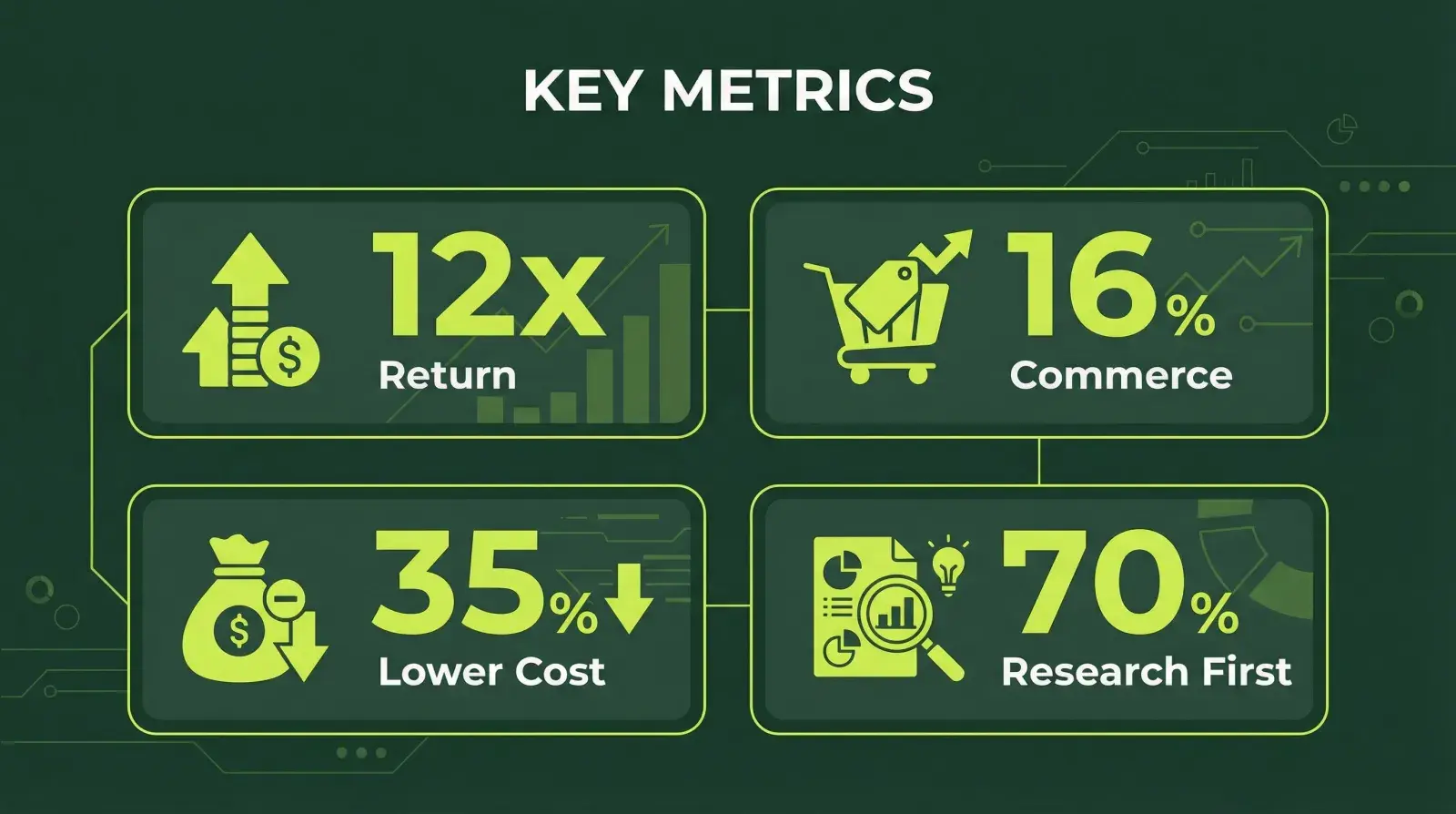
- Affiliate marketing drives 16% of all digital commerce orders (source: Business Insider). B2B is catching up fast.
- 15-30% of total revenue for established affiliate programs comes from partner referrals.
- B2B SaaS companies using affiliate programs report 20-35% lower customer acquisition cost compared to paid advertising.
Buyer behavior
- 70% of B2B buyers complete the majority of their purchase journey before contacting sales (Gartner).
- 67% of purchasing decisions are influenced by peer recommendations and expert content, exactly what affiliates produce.
- 89% of B2B marketers say partner content is more trustworthy than brand content (Demand Gen Report).
ROI
- The average ROI of affiliate marketing is 12:1: for every $1 spent, companies earn $12 back.
- Affiliate marketing has a higher conversion rate than most other digital channels because referrals come with built-in trust.
- Commission-based models mean you only pay for results, no wasted ad spend.
Growth trends
- The affiliate marketing industry is projected to reach $15.7 billion by 2024 (Statista).
- B2B companies increased affiliate marketing budgets by 50% year-over-year in 2023.
- Partner ecosystems are now a core growth strategy for B2B SaaS, not a nice-to-have.
- 81% of brands now use affiliate marketing programs (Rakuten).
- B2B affiliate programs have 3x higher conversion rates than typical display advertising.
The B2B advantage in numbers
Let's compare B2B vs. B2C affiliate economics:
B2C (typical)
- Average Order Value: $50-100
- Commission per Sale: $5-15
- Customer Lifetime: 1 purchase
- Affiliate Lifetime Value: $5-15
- Cookie Window: 7-30 days
B2B SaaS
- Average Order Value: $1,200-12,000/year
- Commission per Sale: $200-2,000+
- Customer Lifetime: 24-48 months
- Affiliate Lifetime Value: $500-5,000+
- Cookie Window: 90-180 days
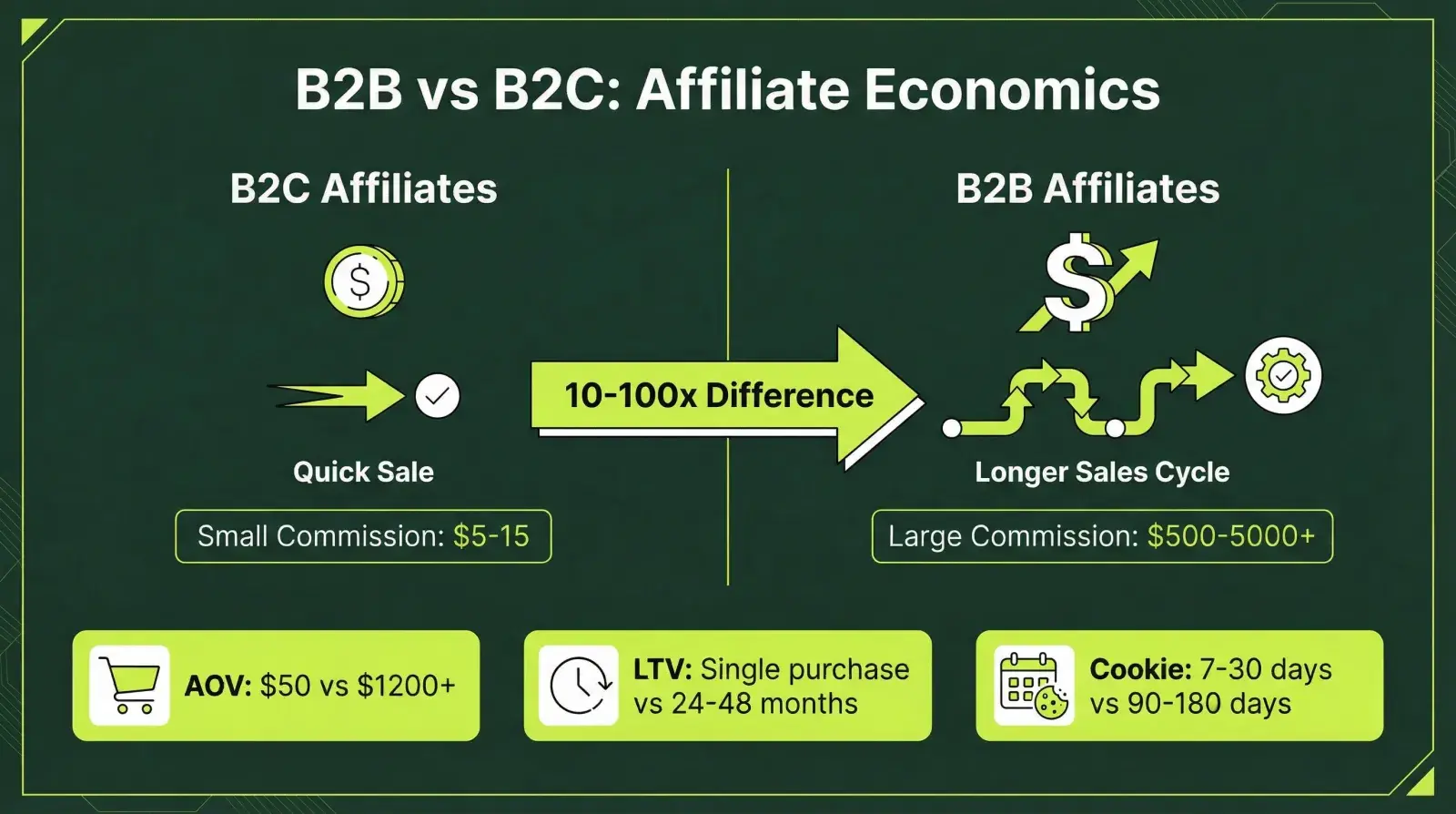
B2B affiliates can earn 10-100x more per referral than B2C affiliates. That attracts better partners.
The data is clear: B2B affiliate marketing works. But why does it actually work better for B2B than B2C?
Why affiliate marketing works even better for B2B
Here's the counterintuitive truth: the things that make B2B "harder" actually make affiliate marketing more effective.
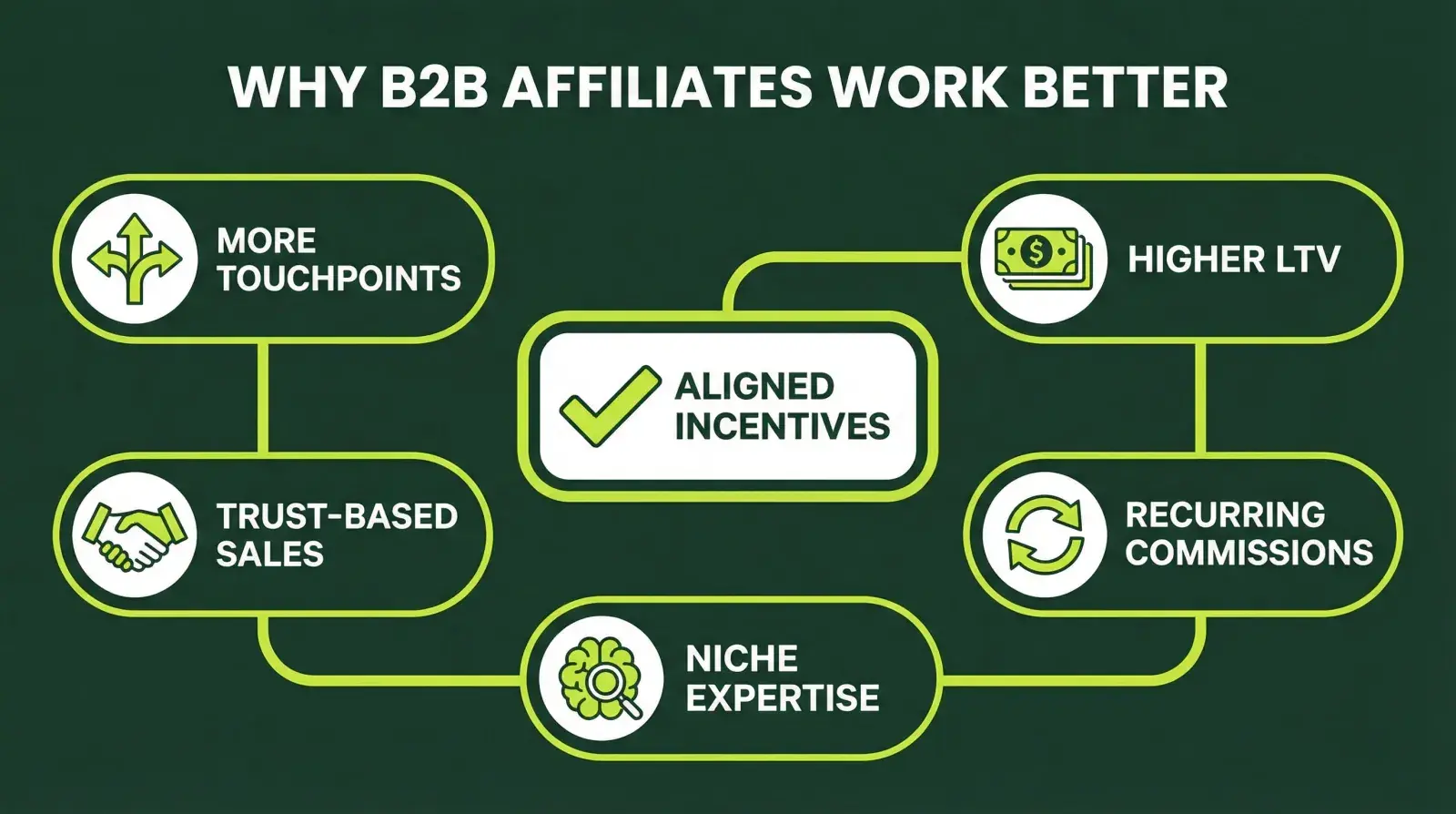
Higher LTV = higher commissions = more motivated affiliates
B2C products have low margins. A $50 product with a 10% commission means $5 per sale. Not exactly life-changing.
B2B SaaS? A $200/month product with a 20% recurring commission means $40/month per customer; potentially $480+ per year. Affiliates are far more motivated to promote products with meaningful commissions.
Recurring revenue = recurring commissions = aligned incentives
Here's the magic of B2B affiliate programs: you can pay recurring commissions tied to subscription revenue.
When an affiliate earns 20% of a customer's subscription every month, their incentive is to refer customers who will stick around. They'll promote to the right audience. They'll set realistic expectations. They become partners in your retention, not just acquisition.
This is impossible with one-time B2C purchases.
Niche expertise matters more than follower count
B2C affiliates need massive audiences. You need millions of views to make meaningful money on $3 commissions.
B2B is different. A consultant with 500 LinkedIn followers in your exact niche can drive more qualified leads than a general influencer with 500K followers. Expertise and trust matter more than reach.
This opens up affiliate marketing to industry experts, consultants, complementary tools, and even your existing customers, people who would never call themselves "influencers."
Trust-based sales = affiliate recommendations carry more weight
B2B purchases are high-stakes decisions. Buyers need confidence they're making the right choice. They seek validation from trusted sources.
An affiliate recommendation from a respected industry expert carries enormous weight. It's not a random internet ad, it's a personal endorsement from someone the buyer already trusts.
Longer sales cycles = more touchpoints for affiliate influence
B2C is often one-click impulse purchases. B2B involves research, demos, trials, and committee approvals.
Every touchpoint in that journey is an opportunity for affiliate content to influence the decision. A blog post that introduces a lead might not convert for 3 months, but when that lead finally signs up, the affiliate still gets credit (with proper cookie windows).
B2B SaaS companies crushing it with affiliate programs
Theory is nice. Let's look at B2B companies that are actually making affiliate marketing work.
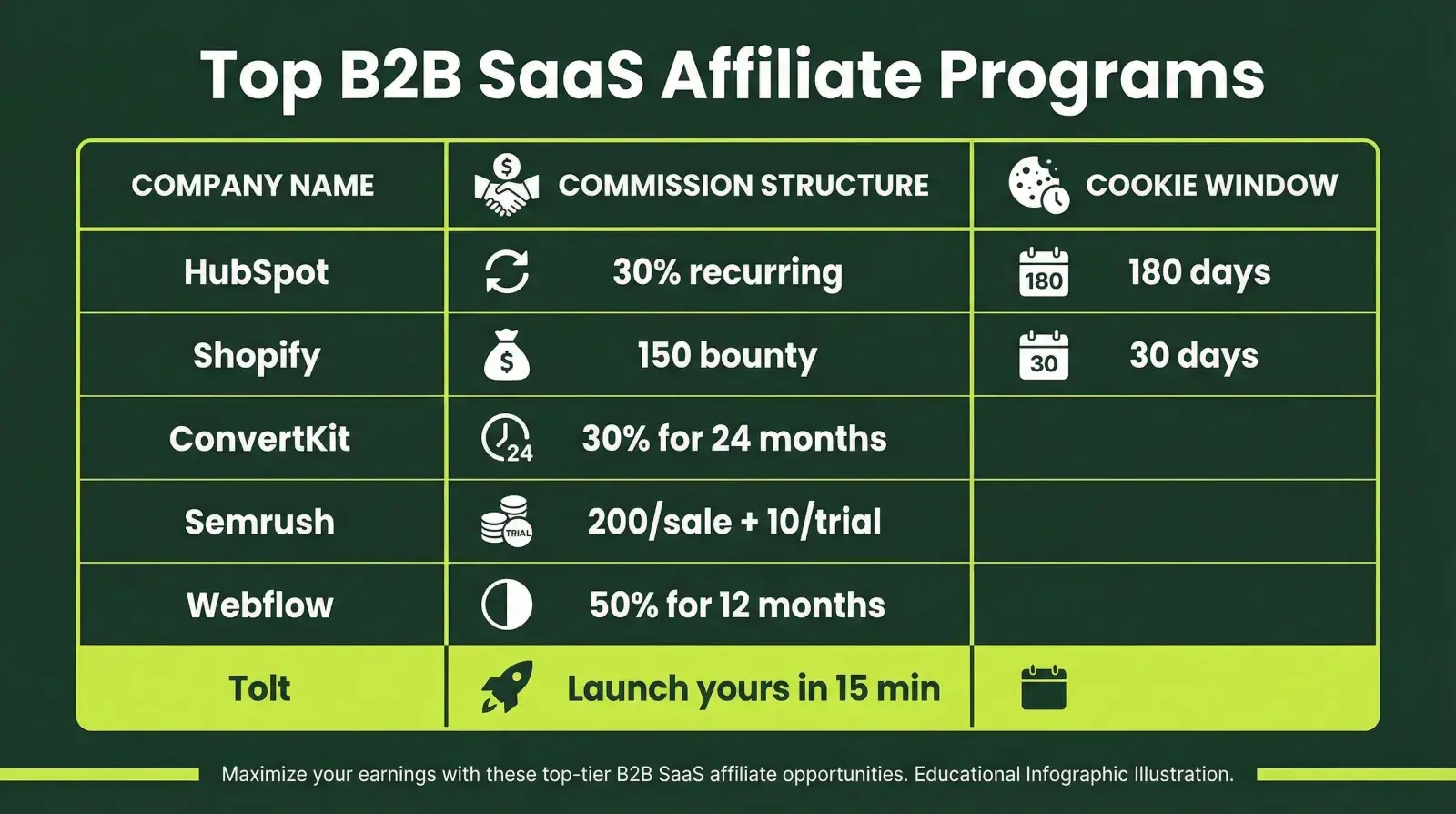
HubSpot
Commission: 30% recurring for up to 1 year (up to $1,000/month) Cookie window: 180 days
HubSpot built one of the largest B2B affiliate programs in SaaS. Their partner ecosystem includes agencies, consultants, and content creators who earn recurring commissions for every referral.
Why it works: High commissions, long cookie windows, and excellent affiliate resources. HubSpot treats affiliates as true partners, not just a marketing channel.
Shopify
Commission: 200% bounty (up to $150 per referral) Cookie window: 30 days
Shopify's affiliate program targets content creators, developers, and e-commerce experts. While technically B2C-focused, their program structure is a masterclass in B2B partner marketing.
Why it works: Generous bounties and a simple signup process. Shopify makes it easy to get started and profitable quickly.
ConvertKit
Commission: 30% recurring for up to 24 months Cookie window: 90 days
ConvertKit targets the creator economy! People building email lists and digital businesses. Their affiliate program is heavily promoted to their own customers.
Why it works: Recurring commissions for 2 years creates true partnership. Affiliates are invested in ConvertKit's success long-term.
Semrush
Commission: $200 per sale, $10 per trial signup Cookie window: 120 days
Semrush is a $30K+ ACV product in some tiers. Their affiliate program drives significant revenue through SEO professionals and marketing agencies.
Why it works: Hybrid model (bounty + trial bonus) works well for high-consideration products. The $10 trial bonus keeps affiliates engaged even when deals take time to close.
Notion
Commission: Variable based on partner tier Cookie window: 30 days
Notion's partner program focuses on creators, consultants, and template builders. Rather than pure affiliate commissions, they offer revenue sharing on templates and integrations.
Why it works: Aligns affiliate incentives with product ecosystem growth, not just signups.
Webflow
Commission: 50% recurring for 12 months Cookie window: 90 days
Webflow's program targets designers and agencies, the exact people who recommend website tools to their clients.
Why it works: 50% recurring is aggressive, but it attracts serious affiliates who build their business around Webflow recommendations.
What these programs have in common
Every successful B2B affiliate program shares these traits:
- Generous, recurring commissions that make promotion worthwhile
- Long cookie windows that account for B2B sales cycles
- Professional affiliate portals with tracking and resources
- Targeted recruitment of industry experts, not random influencers
- Strong product-market fit: affiliates only promote products their audience actually needs
Notice what's not on the list: massive advertising budgets, huge influencer partnerships, or complex enterprise software.
You can build a B2B affiliate program with the same fundamentals. Here's how.
How to set up a B2B affiliate program that actually works
Ready to launch your own B2B affiliate program? Here's the step-by-step.
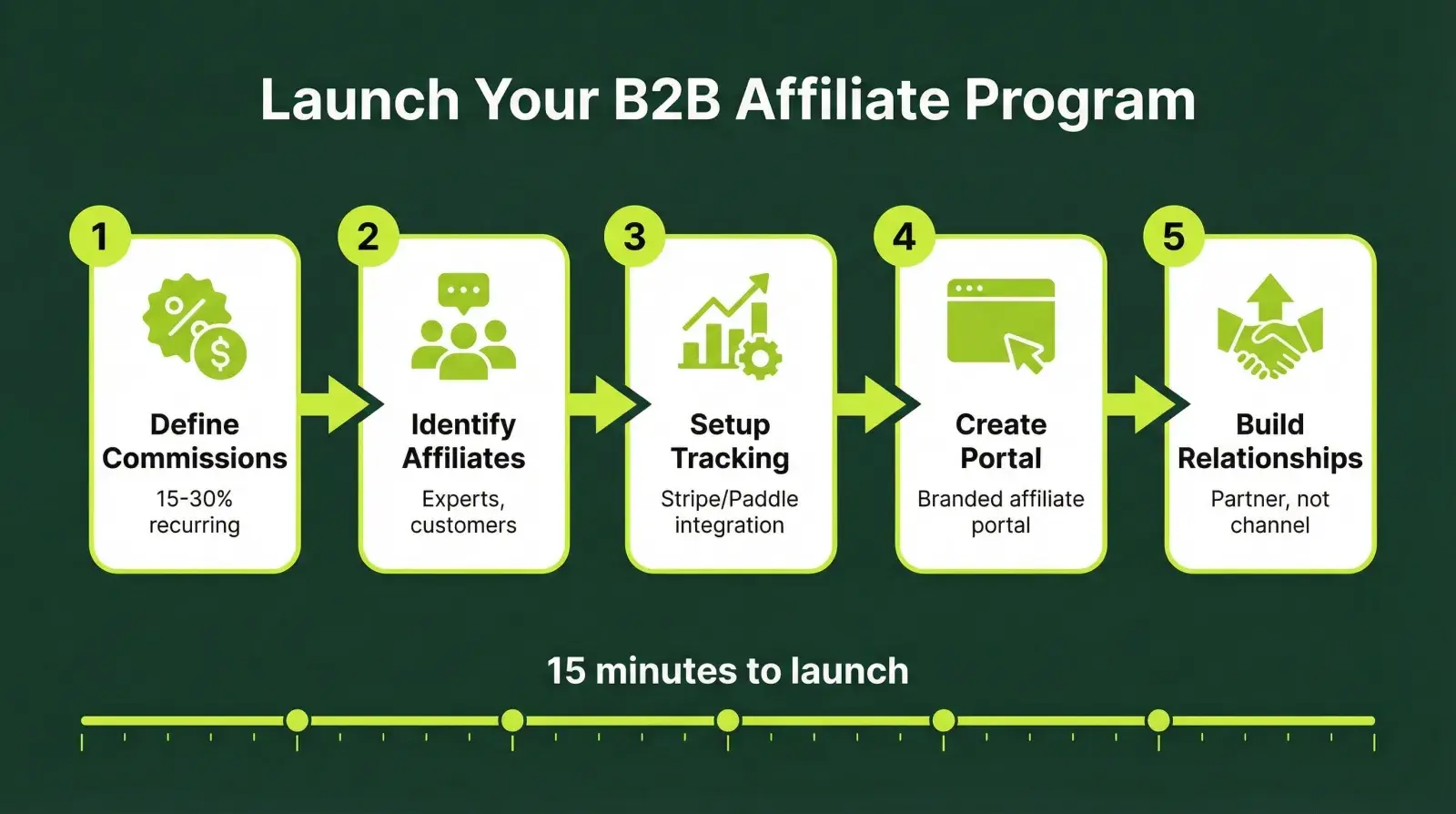
Step 1 of 5: Define your commission structure
You have two main options:
Percentage of revenue (recurring) Best for: SaaS with subscription revenue Example: 20% of MRR for the customer's first year Pro: Aligns affiliate incentives with retention Con: Harder to predict costs
Fixed bounty (one-time) Best for: High-ACV sales or simple tracking Example: $500 per qualified lead, $2,000 per closed deal Pro: Predictable costs Con: Doesn't incentivize quality referrals
Cookie duration: Use 90+ days for B2B. Your sales cycle is longer than B2C, your cookie window should be too.
Step 2 of 5: Identify your ideal affiliates
B2B affiliates aren't Instagram influencers. They're professionals with credibility in your industry.
Industry experts and consultants People who advise your target customers. If you sell HR software, HR consultants are your ideal affiliates. They're already recommending tools to their clients, why not pay them for it?
Look for consultants with:
- Active LinkedIn presence in your industry
- Speaking engagements at relevant conferences
- Published content (blogs, podcasts, YouTube)
- Client bases that overlap with your ICP
Complementary tool companies Products that integrate with yours or serve the same audience. These are partnership opportunities, not just affiliate signups.
Example: If you sell email marketing software, affiliate with CRM tools, landing page builders, and course platforms. Their customers need what you sell.
Content creators in your niche YouTube channels, newsletters, and blogs focused on your industry. They're already creating content for your audience, they just need a reason to mention you.
The best B2B content creators:
- Have engaged audiences (comments, shares, replies)
- Create educational, not entertainment, content
- Already mention competitor products
- Have email lists (higher conversion than social followers)
Your existing customers The best affiliates are people who already use and love your product. They have credibility and authentic enthusiasm that no marketing budget can buy.
How to activate customers as affiliates:
- Email your customer base about your affiliate program
- Offer bonus incentives for the first 3 referrals
- Make signup dead simple (one-click enrollment)
- Highlight successful customer-affiliates in your marketing
Step 3 of 5: Make it easy to track
This is where most B2B affiliate programs fail. Manual tracking doesn't scale.
You need software that:
- Integrates with your payment processor (Stripe, Paddle, Chargebee)
- Tracks trial-to-paid conversions (not just signups)
- Handles cross-domain tracking (marketing site → app → checkout)
- Manages recurring commissions automatically
Tolt handles all of this. Integrate with Stripe, Paddle, or Chargebee in 15 minutes. Automatic tracking, attribution, and payout management.
Step 4 of 5: Provide resources
Don't make affiliates create everything from scratch. Give them:
- Branded affiliate portal with tracking links and performance data
- Case studies and testimonials they can share
- Email templates and swipe files for outreach
- Product screenshots and graphics for content creation
- Comparison pages showing you vs. competitors
The easier you make it, the more affiliates will actually promote.
Step 5 of 5: Build relationships
B2B affiliate programs aren't set-and-forget. The best programs:
- Personally onboard top affiliates with calls and resources
- Offer exclusive perks for high performers (higher commission tiers, early access)
- Communicate regularly with updates, new materials, and performance tips
- Feature successful affiliates in case studies and testimonials
Treat affiliates like partners, not a marketing channel.
5 mistakes that kill B2B affiliate programs
Avoid these common pitfalls:
1. Short cookie windows
A 7-day or 30-day cookie window might work for B2C impulse purchases. B2B sales cycles are 3-6 months. If your cookie expires before the deal closes, you lose the affiliate.
Fix: Use 90-180 day cookie windows. With Tolt, this is configurable per program.
2. One-time commissions only
Paying a one-time bounty doesn't align affiliate incentives with customer quality. Affiliates will send anyone who might convert, regardless of fit.
Fix: Offer recurring commissions tied to subscription revenue. Affiliates earn more when customers stick around.
3. Generic affiliate portals
B2B affiliates are professionals. A generic, template affiliate portal looks cheap and damages your brand.
Fix: Use branded affiliate portals with your domain, colors, and logo. Tolt lets you customizeaffiliates.yourdomain.com.
4. Ignoring existing customers
Companies spend months recruiting random affiliates while ignoring their best source: current customers.
Fix: Email your customer base about your affiliate program. Offer existing customers a simple way to refer others and earn commissions.
5. Manual payout processes
Nothing kills affiliate trust faster than late or incorrect payments. Manual spreadsheets don't scale.
Fix: Automate payouts. Tolt pays affiliates automatically by PayPal, Wise or bank transfer.
Ready to launch your B2B affiliate program?
B2B affiliate marketing works. The data proves it. The examples show it. The only question is whether you'll capture this channel before your competitors do.
Key takeaways
- B2B affiliate marketing drives 16% of digital commerce and growing
- Higher LTV + recurring commissions = more motivated affiliates than B2C
- Your best affiliates are industry experts and existing customers, not influencers
- Long cookie windows (90+ days) are essential for B2B sales cycles
- Automation (tracking, attribution, payouts) is non-negotiable at scale
The tools exist to make B2B affiliate programs easy. You don't need to build tracking infrastructure or manage spreadsheets.

Written by
Damjan, Growth at Tolt

 Capterra

